This page was generated from
docs/tutorials/gcv.ipynb.
Interactive online version:
 .
.
.
Generalized Cross-Validation for Non-Ensemble Models#
[1]:
import sys
sys.path.append('..')

import os
n_cores = int(8)
os.environ["OMP_NUM_THREADS"] = f"{n_cores}"
os.environ["OPENBLAS_NUM_THREADS"] = f"{n_cores}"
os.environ["MKL_NUM_THREADS"] = f"{n_cores}"
os.environ["VECLIB_MAXIMUM_THREADS"] = f"{n_cores}"
os.environ["NUMEXPR_NUM_THREADS"] = f"{n_cores}"
os.environ["NUMBA_CACHE_DIR"]='/tmp/numba_cache'

import numpy as np
from sklearn_ensemble_cv import reset_random_seeds
import matplotlib.pyplot as plt

reset_random_seeds(0)
GCV for risk estimation#
[2]:
from sklearn.linear_model import Ridge, Lasso, ElasticNet
from sklearn_ensemble_cv import generate_data, Ensemble

reset_random_seeds(0)
n_samples, n_features = 1000, 800
Sigma, beta0, X_train, y_train, X_test, y_test, _, _ = generate_data(
    n_samples, n_features, coef='random', func='quad', sigma_quad=.1,
    rho_ar1=0., sigma=.5, df=np.inf, n_test=1000,
)

kwargs_regr = {'alpha': 0.01*X_train.shape[0], 'fit_intercept':False}
kwargs_ensemble = {'max_samples': 0.5, 'bootstrap':False}
regr = Ensemble(estimator=Ridge(**kwargs_regr), n_estimators=1, **kwargs_ensemble)
regr = regr.fit(X_train, y_train)
[3]:
df_gcv = regr.compute_gcv_estimate(X_train, y_train, M0=1, type='union', return_df=True)
df_gcv
[3]:
| M | estimate | err_train | deno | |
|---|---|---|---|---|
| 0 | 1 | 0.986995 | 0.000927 | 0.00094 |
[4]:
df_risk = regr.compute_risk(X_test, y_test, return_df=True)
df_risk
[4]:
| M | risk | |
|---|---|---|
| 0 | 1 | 1.015682 |
GCV for tuning regularization parameters#
[5]:
from sklearn_ensemble_cv import GCV

grid_regr = {'alpha': np.logspace(-3, 0, 10)*X_train.shape[0]}
grid_ensemble = {'max_samples': 1., 'bootstrap':False}

res_gcv, info_gcv = GCV(
        X_train, y_train, Ridge, grid_regr, grid_ensemble,
        M=1, M0=1, corrected=True, type='full', return_df=True, X_test=X_test, Y_test=y_test,
        )
[6]:
res_gcv
[6]:
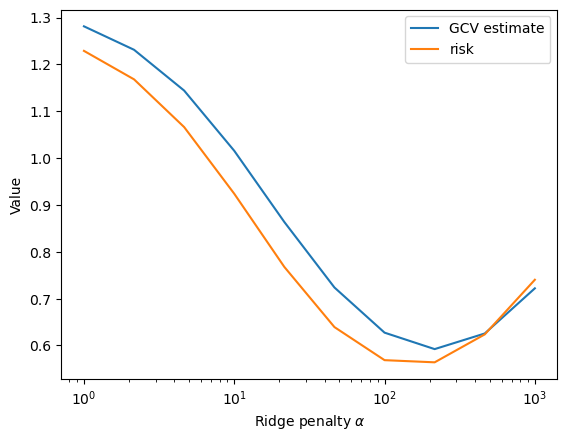
| alpha | risk_val-1 | risk_val-inf | risk_test-1 | |
|---|---|---|---|---|
| 0 | 1.000000 | 1.281178 | NaN | 1.228796 |
| 1 | 2.154435 | 1.231096 | NaN | 1.167976 |
| 2 | 4.641589 | 1.144019 | NaN | 1.066096 |
| 3 | 10.000000 | 1.015488 | NaN | 0.923820 |
| 4 | 21.544347 | 0.863445 | NaN | 0.767550 |
| 5 | 46.415888 | 0.723675 | NaN | 0.639160 |
| 6 | 100.000000 | 0.627298 | NaN | 0.568579 |
| 7 | 215.443469 | 0.592169 | NaN | 0.563968 |
| 8 | 464.158883 | 0.625508 | NaN | 0.623591 |
| 9 | 1000.000000 | 0.721912 | NaN | 0.740226 |
[7]:
info_gcv
[7]:
{'best_params_regr': {'alpha': np.float64(215.44346900318823)},
 'best_params_ensemble': {'random_state': 0,
  'max_samples': 1.0,
  'bootstrap': False,
  'n_estimators': 1},
 'best_n_estimators': np.int64(1),
 'best_params_index': np.int64(7),
 'best_score': np.float64(0.5921689022419518)}
[8]:
res_gcv.iloc[info_gcv['best_params_index']]['risk_test-{}'.format(info_gcv['best_n_estimators'])]
[8]:
np.float64(0.5639675571939373)
[9]:
plt.plot(res_gcv['alpha'], res_gcv['risk_val-1'], label='GCV estimate')
plt.plot(res_gcv['alpha'], res_gcv['risk_test-1'], label='risk')
plt.xscale('log')
plt.xlabel(r'Ridge penalty $\alpha$')
plt.ylabel('Value')
plt.legend()
plt.show()
[ ]: